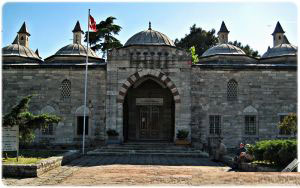
The Museum of Foundation Calligraphy Arts initially was founded in the Madrasah of Sultan Selim in 1969 under the name of Turkish Museum of Calligraphy Arts. In 1984, it was reopened as the Turkish Museum of Foundation Calligraphy in the Madrasah of the complex of Sultan Beyazid the 2nd.
The Madrasah was built between 1506 and 1508 with the Beyazid the 2nd Külliye. In the Northwestern side of the mosque, the square planned classroom section whose top is vaulted, forms the centre of this structure which pertains to the plan of classical Ottoman madrasah. The 3 sides of it consist of 13 rooms. In the execution of it, hewn stones and bricks were used, and for the classroom, stones and bricks were prosecuted consecutively. The entrance door is vaulted and has a very elegant appearance. Upon them a façade which consists of Rumis and Hatayis, is placed. The fronts of the madrasah rooms that have porticos, have plans that akin to square and their tops are vaulted.
There are 14 display sections in the Turkish Museum of Foundations Calligraphy:
The Section of Kufic Koran, Pamphlets; The Handwritten Arts of Indian and Moorish Calligraphy and Tablets
The oldest Koran of Kufic writing that was drawn up by Mehmed bin İdris dating back to IX and X centuries; and the pamphlets belonging to XII century, as well as the Koran that was written in Indian writing of nesih style, kat’a tablets that was written with wooden and ivory materials upon velvet are among the works of art that are displayed in this section.
The Section Of Muhakkak Korans and Sülüs Tablets
The Section of Calligraphic Writings and Tablets
The Section of Sülüs and Paneled Writings
The Section of The Sultans’s Signatures and Nesih Korans
The signatures pertaining to Mahmud the 2nd and Selim the 3rd were written by Mümtaz, Abdullah Tevkii, Vehiç and Kudsi. These are also among the works of art of that section.
The Section of The Calligrapher Sultans, Sülüs and Muhakkak Writings
The calligraphy of Sultan Murad the 3rd which was written in talik stlye, the lectern that was made of walnut and rosewood and the calligraphies of Vahideddin Efendi, Sultan Abdülmecid, Ahmed the 3rd and Mahmud the 2nd are among the works of art exhibited in this section.
The Section of Madrasa Diplomas, Nesih Korans of The Museum
The Section of Hilyes
The Section of Female Calligraphers – Handling Writings
The Section of Meşkler-Muhakkak Korans
The Section of Ethnography
There was an exposure which reflects the ordinary life in madrasah. In this section, via display figures in the clothes of that period, how the calligraphers and the students of those times learned the calligraphy is portrayed for the visitors.
The Section of Sülüs and Nesih Murakkalas
The Section of Relics
The Courtyard of the Museum
The stone epigraphies, an epitaph that dates back to 1798 and two sundials that were made by Ahmed Ziya Bey are displayed in the garden.
Beyazıt Camisi karşısı Beyazıt/ İSTANBUL
Tel: (0212) 527 58 51
|